
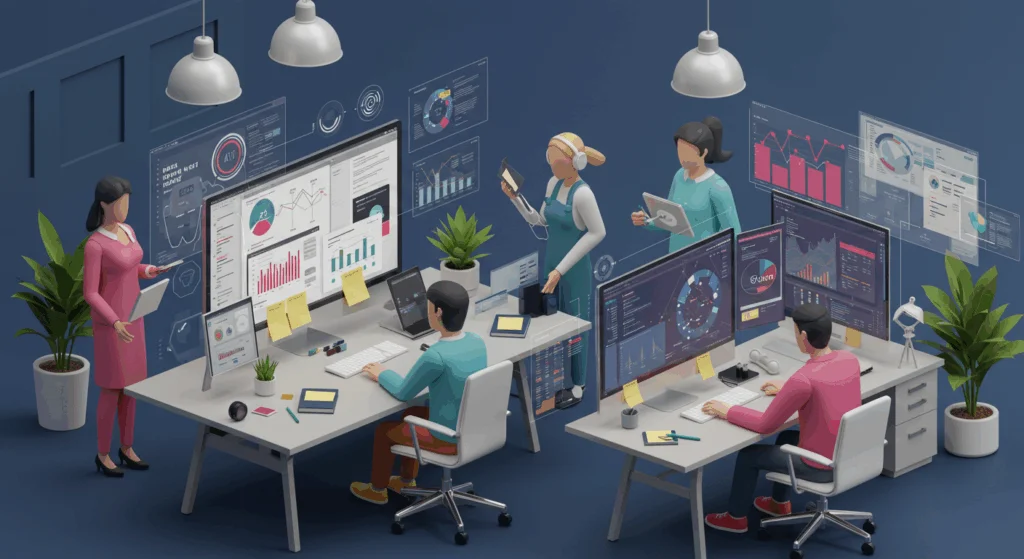
Imagine a world where your marketing campaigns run themselves, adapting in real-time, and your website redesigns itself based on live user behavior. This isn't science fiction anymore. It's the rapidly unfolding reality of AI agent frameworks and platforms, which are moving beyond simple content generation to truly autonomous task execution. The digital world is seeing a profound transformation.
The numbers don't lie. Gartner forecasts that AI agent software spending will reach a staggering $206.5 billion in 2026, a significant jump from $86.4 billion in 2025. This explosion in investment signals a massive shift, pushing businesses towards an "agent-first" marketing approach. Autonomous AI teams are now being built to execute multi-channel strategies with minimal human input, aiming to scale production and cut down on the "execution tax" that often bogs down tactical tasks.
This isn't just about efficiency; it's about a complete rethinking of digital presence and engagement. From how we design websites to how we connect with customers, AI agents are at the heart of the next wave of innovation. Let's explore how these intelligent systems are reshaping web design workflows and digital marketing automation.
The Rise of Autonomous AI Agents in Digital Marketing
The most significant development in digital marketing is the shift towards autonomous execution. AI agents are no longer just tools for generating text or images. They are now capable of end-to-end task execution across entire campaigns, CRM systems, messaging, and complex workflows. This capability dramatically improves speed, consistency, and coverage for marketing initiatives.
Platforms like Montr AI are at the forefront, deploying specialized AI agents for campaign and lead operations. These agents work seamlessly across content creation, CRM management, and various automations, eliminating the need for constant tool switching. This autonomous functionality allows marketers to achieve unprecedented levels of efficiency and responsiveness.
The core concept behind these advanced AI agents is a "perceiving, thinking, and doing" loop. Unlike traditional marketing automation, which follows predefined rules, AI agents can perceive data, make informed decisions, and take actions without continuous human intervention. This context-awareness allows for dynamic adjustments and optimizations that were previously impossible.
Real-world examples illustrate this power. Salesforce's Agentforce, an AI agent framework, is powering intelligent, autonomous marketing execution within its vast ecosystem. Albert.ai leads the way in autonomous paid media buying, managing campaigns across Google, Meta, LinkedIn, and Bing with minimal human input. Demandbase Agentbase orchestrates agentic actions over an intent data layer, significantly enhancing Account-Based Marketing (ABM) programs. HubSpot's AI Layer, known as Breeze, offers agentic capabilities for mid and upper-mid market teams, including AI-based lead scoring and automated follow-ups. These platforms demonstrate the tangible benefits of agentic AI in marketing, reducing overhead and increasing output.
The impact is clear: companies using AI are publishing 42% more content each month, according to industry data. NoimosAI, for instance, enables teams to achieve a 10x increase in content production and reduce marketing overhead by up to 80% through its specialized agents. This level of digital marketing automation is transforming how businesses operate, freeing up human teams for more strategic endeavors.
Redefining Web Design Workflows with Agentic AI
The influence of AI agents extends deeply into web design workflows, promising a future where websites are not just built, but intelligently evolve. The global market for AI-powered website builders is projected to reach $3.41 billion in 2026, with a strong compound annual growth rate (CAGR) of 17.7% between 2026 and 2035. This growth underscores the significant role AI is playing in transforming how digital experiences are crafted.
AI agents are moving beyond template selection and simple drag-and-drop interfaces. They are now capable of autonomous web design, adapting layouts and content in real-time. Consider platforms like The Grid, an early example of an autonomous web design agent that could adapt web layouts on the fly. More recently, CodeCraft AI analyzes wireframes and automatically produces responsive layouts, drastically cutting down design time and development effort. These innovations are fundamentally changing how sites are conceived and brought to life.
This agentic approach to web design means that websites can become truly adaptive. Instead of static pages, we're seeing designs that adjust content, layout, and functionality based on real-time user behavior and preferences. This level of dynamic personalization, powered by AI agents, promises more engaging and effective online presences. It also means that the initial "build" of a website is just the beginning, as AI agents continuously optimize and refine the user experience.
For businesses looking to quickly launch or revamp their online presence, AI website builders like BuildEZ.ai are becoming indispensable. These platforms use AI agents to create complete, production-ready websites, often in minutes, democratizing access to high-quality web design. They streamline complex web design workflows, allowing businesses to focus on their core mission rather than getting bogged down in technical details. This shift enables faster iteration and more responsive design, keeping pace with ever-changing market demands.
Hyper-Personalized User Experiences: The Agentic Advantage
One of the most profound impacts of AI agents is their ability to deliver hyper-personalized user experiences at an unprecedented scale. This goes far beyond simple recommendations or A/B testing; it involves dynamically adapting every element of a user's interaction based on their real-time behavior, preferences, and context.
AI agents can analyze vast amounts of data, from browsing history and purchase patterns to immediate clicks and scroll depth, to construct a highly individualized user profile. With this intelligence, they can then modify website content, adjust layout elements, suggest relevant products, or even alter functionality to create a truly bespoke experience. This level of personalization leads to increased engagement, builds greater trust, and fosters stronger customer loyalty.
CleverTap's CleverAI™ exemplifies this agentic advantage. It's an AI decisioning engine that employs a team of specialized agents: strategy agents define objectives, decision agents determine optimal actions, creative agents generate tailored content, and action agents execute campaigns. This multi-agent system ensures that every customer touchpoint is deeply personalized, from email communications to in-app experiences.
The result is a website or digital campaign that feels uniquely crafted for each visitor. If an AI agent detects a user is struggling to find information, it might proactively offer a chatbot or suggest relevant articles. If a user shows interest in a specific product category, the website might dynamically reconfigure its homepage to highlight related items or promotions. This adaptive approach, driven by agentic AI, transforms passive browsing into an active, responsive conversation between the user and the digital platform.
This focus on individualized interactions is a major competitive differentiator. Businesses that can offer these personalized user experiences will stand out in a crowded digital marketplace, converting more visitors into loyal customers by making every interaction feel relevant and valuable.
AI in Search and the Future of Discoverability
The way people find information online is undergoing a radical transformation, largely due to the rise of AI Overviews and advanced AI search engines like SearchGPT. This shift fundamentally alters how businesses need to approach their online presence, particularly in terms of discoverability by AI agents.
By the end of 2026, Gartner predicts that 40% of enterprise applications will feature embedded AI agents. This means that not only are human users interacting with AI in search, but AI agents are also increasingly searching for, processing, and interpreting information online. This has profound implications for how websites, especially product pages, are designed and optimized.
Retailers are already starting to optimize their product pages specifically for discoverability by AI agents. This involves ensuring content is structured, clear, and comprehensive, making it easy for AI agents to extract key information, compare products, and understand nuances. A modernretail.co report highlighted this trend, emphasizing the need for robust product data that AI can readily parse. The days of solely optimizing for human eyeballs are evolving; now, we must also cater to the digital eyes of AI.
Furthermore, the concept of Agent-to-Agent (A2A) commerce is predicted to normalize by 2026. This scenario envisions buyer AI agents autonomously negotiating with seller AI agents, making purchasing decisions based on predefined criteria, pricing, and availability. This future requires businesses to have digital presences that are not only human-readable but also machine-readable and actionable by other AI systems. This means precise data, clear product specifications, and accessible APIs will become critical components of any effective online strategy.
This evolution in search and commerce underscores the importance of a well-structured, AI-friendly web presence. Businesses must consider how their content, data, and website architecture facilitate efficient processing by intelligent agents, ensuring they remain discoverable and competitive in an increasingly AI-driven digital ecosystem.
The “Command Marketing” Model and Human-in-the-Loop
While AI agents promise unprecedented autonomy, the future of digital marketing and web design isn't about replacing humans entirely. Instead, it's about a powerful new collaboration, often termed the "Command Marketing" model. In this setup, humans retain their crucial role in setting strategic goals, defining brand identity, and making complex judgments, while AI agents handle the vast majority of tactical execution.
The human-in-the-loop approach remains essential. AI agents operate with remarkable efficiency, but they lack human intuition, creativity, and the ability to navigate highly nuanced ethical or brand-sensitive situations. Human oversight ensures that AI-driven campaigns align perfectly with overarching business objectives and brand values. Forbes highlighted this trend in May 2026, emphasizing agentic teamwork and everyday task automation, with humans guiding the strategy.
This shift frees human marketers and designers from repetitive, time-consuming tasks. Instead of spending hours on data entry, campaign deployment, or basic content creation, teams can now dedicate their energy to high-level strategic planning, innovative creative development, and fostering deeper customer relationships. Sprinklr, for instance, discusses autonomous AI agents for marketing optimization, focusing on continuous analysis and dynamic adjustments under human guidance.
The goal isn't to remove humans from the equation, but to elevate their role. By mid-2026, building an AI team for marketing won't just be an advantage, it will be a competitive necessity. This doesn't mean hiring robots, but rather integrating sophisticated AI development platforms and agentic tools into existing teams. These platforms act as force multipliers, allowing smaller teams to achieve the output and reach of much larger organizations.
Ultimately, the "Command Marketing" model positions humans as the conductors of an incredibly powerful orchestra of AI agents. This synergy allows for both massive scale and highly refined, personalized experiences, ensuring that the strategic vision remains firmly in human hands while execution is optimized by AI.
Practical Steps for Businesses: Embracing the Agent-First Era
The rapid advancements in AI agents present both challenges and immense opportunities for businesses. To stay competitive and thrive in this evolving digital landscape, taking proactive steps to integrate AI into your operations is no longer optional, it's essential.
First, start experimenting with AI in marketing tools. Many platforms now offer agentic capabilities, even if they aren't fully autonomous. Platforms like HubSpot Breeze or Salesforce Agentforce provide excellent entry points for automating lead scoring, content distribution, and customer follow-ups. Begin by identifying specific, repetitive tasks that AI agents could manage, freeing up your team for more strategic work.
Second, re-evaluate your web design workflows. Are your current processes agile enough to handle dynamic, AI-driven personalization? Consider how your website's content and structure can be optimized for both human and AI readability. This includes clear metadata, semantic HTML, and well-organized information that AI agents can easily parse for search and A2A commerce. Investing in an AI-powered website builder like BuildEZ.ai can dramatically accelerate this process, allowing you to quickly deploy and adapt your online presence to new AI demands.
Third, shift your team's focus. Encourage marketers and designers to embrace strategic thinking, creative problem-solving, and relationship building. With AI agents handling 80-90% of tactical marketing tasks, human talent can be reallocated to areas where human creativity and judgment are irreplaceable. This means fostering skills in prompt engineering, AI oversight, and data interpretation, rather than manual execution.
Fourth, prioritize hyper-personalization. The data shows that AI-optimized content is associated with 32% higher engagement rates and 47% better conversion rates. Explore how AI agents can deliver tailored experiences across all your digital touchpoints, from your website to email campaigns. Tools like CleverAI™ by CleverTap offer frameworks for developing these adaptive strategies.
Finally, stay informed and embrace continuous learning. The field of AI is evolving at an astonishing pace. Regularly review industry reports, attend webinars, and encourage your team to engage with new AI development platforms and frameworks. The businesses that adapt quickly and intelligently will be the ones that redefine success in the agent-first era.
The future of web design and digital marketing is here, driven by the power of AI agents. Ready to build your AI-powered website and step into this exciting new future? Visit BuildEZ.ai today to see how easy it is to create a complete, production-ready website that's ready for the age of autonomous AI.