
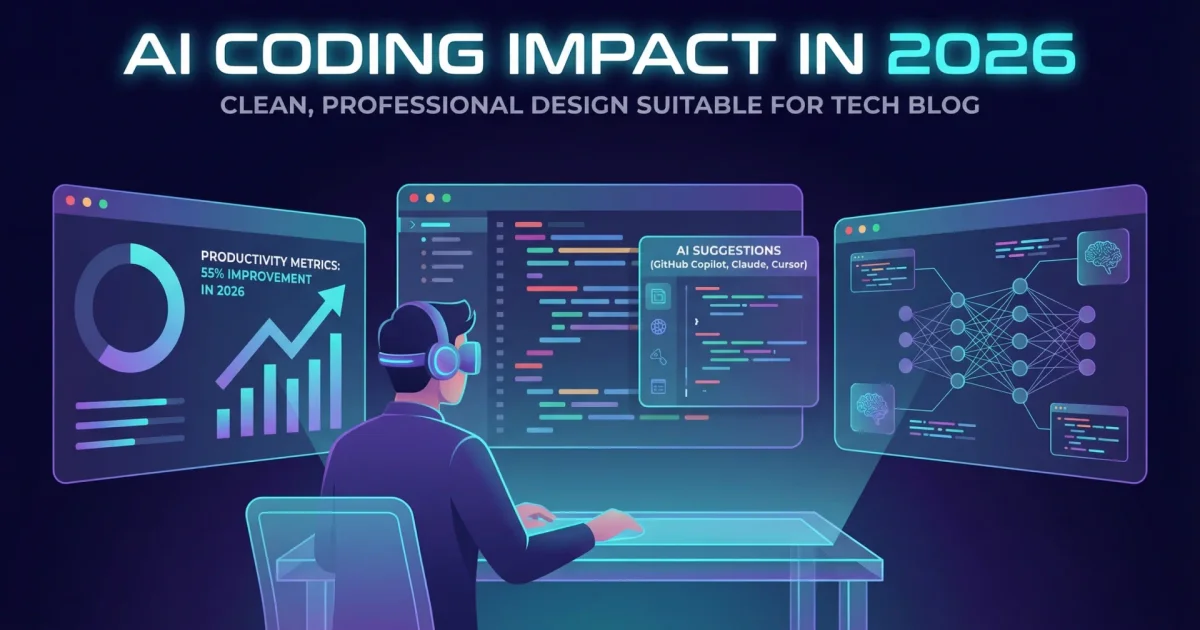
What if you could build a high-performing website in three days instead of three weeks? That's not a hypothetical for tomorrow, it's the reality for agencies like Grow Law today, thanks to AI as a co-pilot, as noted by Chief Growth Officer Sasha Berson. The web development world has undergone a seismic shift, and May 2026 finds us firmly entrenched in an AI-first era.
nnPredictions suggest that by the end of this year, a staggering 90% of code will be AI-generated. This isn't just about faster code completion; it's a fundamental redefinition of how we build, deploy, and maintain digital experiences. Let's look at the comprehensive overview of recent web development developments shaping our industry.
nnAI-First Development: The New Normal for Web Development
nnThe past year, 2025, was truly pivotal. AI tools didn't just improve; they reportedly tripled developer productivity, accelerating the pace of change exponentially. Fast forward to May 2026, and AI-first development isn't an aspiration, it's the standard operating procedure for web development teams everywhere. We've moved beyond simple suggestions to AI scaffolding entire full-stack applications and enabling complex agentic workflows where developers guide intelligent AI systems. As Mikael Saakyan, Co-founder and Managing Partner at Rattlesnake Group, puts it, AI will be an everyday part of web development, handling tasks like code generation, testing, accessibility checks, and performance improvements in the background (Source: techround.co.uk).
nnThese sophisticated AI tools are now core components of the development lifecycle. They generate components, explain intricate code, trace data flow across complex systems, and even surface obscure edge cases. This dramatically shortens onboarding times for new team members and makes navigating large, legacy systems far more manageable. Tools like GitHub Copilot, Claude AI by Anthropic, and Cursor are deeply integrated into developer workflows, making AI a true creative partner. OpenAI's significant $3 billion acquisition of Windsurf in May 2025 underscores the industry's commitment to scaling AI-assisted coding and creating new integration hooks for web development pipelines.
nnMeta-Frameworks and Full-Stack Fusion: Blurring the Lines
nnThe dominance of meta-frameworks like Next.js and Nuxt has solidified, becoming the default entry points for most professional web projects. These aren't just libraries; they're comprehensive solutions, offering one-stop shops for everything from routing and data fetching to caching, rendering strategies, and API layers. Companies like Vercel, for Next.js, and Nuxt, for Vue.js, exemplify this trend, abstracting away much of the underlying infrastructure complexity.
nnThe stabilization of Server Actions and Server Functions has been a game-changer, effectively collapsing the traditional backend into a folder within the frontend repository for many applications. This means the line between frontend and backend is fading fast, pushing web development towards a full-stack expectation. TypeScript's role continues to grow, enabling backend logic to be expressed as typed functions, which eliminates common issues around API contracts and manual type maintenance. It's a cleaner, more robust way to build.
nnFurther enhancing this efficiency, the React Compiler reached its 1.0 release in October 2025 and has seen increased adoption. This compiler automatically handles memoization and performance tuning at build time, rendering manual `useMemo`, `useCallback`, and `React.memo` largely unnecessary. This allows developers to focus on features and logic, trusting the compiler to optimize performance, a significant boon for complex applications. This is where platforms like BuildEZ.ai shine, by offering frameworks and optimizations out-of-the-box, letting creators focus on their vision.
nnPerformance, Edge, and Immersive Experiences
nnUser expectations for instant loading and responsiveness are at an all-time high. Websites that load in under 2.5 seconds see an average increase of 15% in conversion rates. Conversely, a staggering 53% of mobile users abandon websites that take longer than 3 seconds to load (Source: scalinghigh.com). This intense focus on speed has driven more applications to the edge, optimizing performance and drastically reducing latency by bringing content closer to the user.
nnBeyond speed, the web is becoming smarter and more immersive. AI is powering hyper-personalization engines, sophisticated chatbots, intelligent support interfaces, and predictive user experiences that adapt content based on behavior, location, and choices. Natural Language Processing (NLP) and voice-enabled interfaces are rapidly becoming mainstream, allowing users to navigate websites using speech and conversational commands.
nnLooking ahead, browsers are evolving towards 3D, augmented reality (AR), and truly immersive experiences, blurring the line between traditional web design and experience design. AR website integrations alone increased by 45% in 2026, pointing to a future where the web is a portal to spatial computing. Progressive Web Apps (PWAs) are also leading growth at a 13.45% CAGR, projected to reach USD 21.44 billion by 2033, as they deliver native-like performance without the cost of separate iOS and Android builds (Source: softjourn.com).
nnThe Evolving Developer Role: Architect, Not Coder
nnWith AI handling much of the boilerplate, the role of the web developer is undergoing a profound transformation. Developers will write less repetitive code and more intent, acting as architects who oversee and guide AI agents. The focus shifts from typing every line to making critical architectural decisions, designing robust systems, implementing complex business logic, and conducting thorough code reviews. Human judgment remains absolutely essential for long-term planning, risk management, and ensuring the ethical implications of AI-generated solutions are considered.
nnThis evolution also means the 'full-stack' developer is becoming the new normal. The fading line between frontend and backend means modern developers are increasingly expected to build APIs, work with databases, understand deployment pipelines, and handle authentication and security. Companies are showing a clear preference for generalists who can navigate all aspects of web development, from concept to deployment. This is a significant shift from specialized roles we saw just a few years ago.
nnBeyond Code: Security, Accessibility, and Simplicity
nnIn 2026, security is no longer an afterthought; it's a fundamental part of everyday web development. Frameworks are moving towards stronger defensive defaults, improved static analysis tools, and closer integration with security scanners. Cybersecurity knowledge is now a requirement in 38% of full-stack developer job listings, reflecting its critical importance (Source: scalinghigh.com). With global cybersecurity spending predicted to exceed $1.75 trillion cumulatively from 2021 to 2026, the industry is investing heavily in making the web safer.
nnAccessibility and inclusivity are also non-negotiable. Building for everyone, regardless of ability, impacts user experience, SEO, and legal compliance. It's a moral imperative and a smart business decision. Furthermore, in a world of increasing complexity, simplicity is winning. Over-engineering is a common mistake; developers are encouraged to prioritize clear architecture, intuitive user experience, and direct intent, opting for simpler solutions when appropriate. This mindset helps keep projects maintainable and scalable.
nnThe Business Impact: Market Growth and AI's Promise
nnThe web development services market is experiencing robust growth, driven by continuous digital transformation and the increasing need to embed generative AI features into applications. Valued at USD 80.6 billion in 2025, it's estimated to grow to USD 87.75 billion in 2026, with some reports projecting it to reach USD 134.17 billion by 2031 at a CAGR of 8.87% (Source: mordorintelligence.com, businessresearchinsights.com). This growth is fueled by a global developer workforce of approximately 27.7 million in 2025, projected to reach 45 million by 2030 (Source: talent500.com).
nnLow-code and no-code platforms are also playing a significant role in this expansion. Gartner expects low-code development tools to account for 75% of new application development by 2026, with the global low-code market projected to reach $86.9 billion by 2027 (Source: techsolutionor.com). These platforms empower a broader range of individuals and businesses to create digital solutions, democratizing access to web development.
nnThis is where platforms like BuildEZ.ai fit in perfectly. By abstracting away much of the coding complexity and leveraging AI to generate production-ready websites, BuildEZ.ai allows businesses and individuals to capitalize on these trends without needing a dedicated team of full-stack developers. It's an example of how AI is making web creation more accessible and efficient for everyone.
nnLooking Ahead: An Exciting Future for Web Development
nnThe web development landscape in May 2026 is dynamic, challenging, and incredibly exciting. The shift to AI-first development, the maturity of meta-frameworks, and an intensified focus on performance, security, and developer experience are not just trends; they are foundational changes. Developers are evolving into architects, guiding intelligent systems to create more immersive, personalized, and efficient digital experiences.
nnThe future isn't about writing every line of code; it's about defining intent, designing systems, and overseeing the powerful AI agents that bring those visions to life. For businesses, this means faster development cycles, more innovative products, and the ability to adapt quickly to market demands. Embracing these changes is key to staying competitive and thriving in the digital age.
nnReady to experience the future of web development firsthand? Explore how AI can transform your website creation process. Visit BuildEZ.ai today and discover how easy it is to build complete, production-ready websites with the power of artificial intelligence.