Did you know that by 2026, an estimated 80% of entry-level creative jobs will require some level of AI proficiency? That's a big shift, and it means the tools we use every day need to evolve. We are in June 2026, and the world of AI workstations is experiencing a massive transformation.
nNo longer are powerful AI capabilities locked away in distant cloud servers. Instead, they are moving right to your desk, making complex tasks more accessible than ever. This move to 'on-device' AI processing is changing how we work, offering huge benefits for creators, data scientists, and businesses alike. Let's explore what's new and what it means for you.
nnThe Engine Room: What Makes an AI Workstation Tick?
nThink of an AI workstation as a high-performance sports car, custom-built for speed and power in the world of artificial intelligence. Each component plays a vital role in letting you run complex AI models, train neural networks, and process vast amounts of data right where you are.
nnGPUs: The Muscle of AI
nGraphics Processing Units, or GPUs, are the heavy lifters for AI tasks. They are incredibly good at doing many calculations at once. NVIDIA continues to lead this area with its Blackwell architecture. The NVIDIA RTX PRO 6000 Blackwell Workstation Edition GPUs are top-tier, providing extreme AI compute capabilities [Source: newegg.com].
nFor those looking for cutting-edge power, the NVIDIA RTX 5090 is a standout, featuring 32GB of GDDR7 memory and Blackwell architecture with support for FP8/FP4, which are specialized formats for AI calculations. It's a top choice for fine-tuning AI models and running inferences. If your budget is a bit tighter, the RTX 5080 with 16GB of memory is a good option. Even a used RTX 4090, which has 24GB of memory, remains a strong performer for many tasks [Source: ant-pc.com].
nnCPUs: The Brain for Orchestration
nWhile GPUs handle the heavy AI computations, Central Processing Units (CPUs) are the brains that manage everything else. High-core-count processors are essential for getting your data ready, preprocessing it, and making sure all the different parts of your system work together smoothly.
nAMD offers its powerful Ryzen Threadripper PRO series. Models like the Threadripper 7980X give you up to 64 cores and 128 threads, plus 128 PCIe 5.0 lanes. This means you can connect multiple GPUs without bottlenecks [Source: amd.com, servermonkey.com]. AMD also has the Ryzen AI 9 HX PRO 470 CPUwhich includes a Radeon 890M GPU and a powerful 55 TOPS NPU for efficient AI tasks.
nIntel isn't far behind, with its new Xeon 600 Processors for workstations. These claim up to a 9% improvement in single-threaded performance and a huge 61% improvement in multi-threaded performance over previous generations [Source: storagereview.com]. Intel Core Ultra Series 3 processors also come with a 50 TOPS NPU built in.
nnNPUs: AI Accelerators for Efficiency
nNeural Processing Units, or NPUs, are dedicated chips designed specifically for AI tasks. They are becoming a standard feature in new CPUs because they handle AI workloads very efficiently and with less power. Qualcomm's Snapdragon X Elite and next-gen Snapdragon X platforms are delivering 75, 85 TOPS (Trillions of Operations Per Second) [Source: microsoft.com].
nAMD's Ryzen AI 300 and Ryzen AI Max series push 50, 75 TOPS, while Intel's Core Ultra Series 2 (Lunar Lake) and upcoming Arrow Lake platforms combine 45, 55 TOPS standalone with additional graphics processing unit (iGPU) capabilities, reaching 150, 180+ TOPS total [Source: hp.com, ordinarytech.ca]. These NPUs are crucial for running many AI applications smoothly on your device.
nnMemory and Storage: The Workspace and Filing Cabinet
nJust like a busy desk needs plenty of space, AI applications need a lot of memory. Professional workstations in 2026 demand substantial DDR5 memory. Most AI and creative applications work best with at least 64GB, and many professionals are choosing 128GB or even 256GB. Memory bandwidth, which is how fast data can move in and out of memory, is also increasingly important for NPU workloads [Source: smythos.com]. It's worth noting that memory prices are on the rise, with 64GB DDR5 RDIMMs increasing by approximately 11% month-over-month in June 2026 [Source: digitalengineering247.com].
nFor storage, you need a very fast digital filing cabinet. High-speed NVMe SSDs, such as the Samsung 990 Pro and WD Black SN850Xare essential. They allow for quick loading of large datasets, rapid preprocessing, and fast saving of model checkpoints [Source: buildez.ai].
nnWhy Local AI Wins: Privacy, Speed, and Savings
nThe shift towards doing AI processing right on your device, rather than relying solely on cloud services, brings many important advantages. It is like having your own dedicated workshop instead of renting tools from a big, shared factory.
nOne major benefit is **data privacy**. When your AI processes data locally, that sensitive information never leaves your control. This is a big deal for businesses and individuals who handle confidential data [Source: buildez.ai]. You don't have to worry about your data traveling across the internet or residing on someone else's servers.
nAnother advantage is **iteration speed**. Imagine making a small change to an AI model and wanting to test it immediately. With a local AI workstation, the feedback loop is much faster. You can test, tweak, and re-test without waiting for data to upload or for cloud resources to become available [Source: buildez.ai]. This can reduce development and prototyping cycles by up to 70% when generative AI is effectively integrated.
nFinally, there are **long-term cost efficiencies**. While the initial investment in a powerful AI workstation might seem high, it can save money over time compared to continuous cloud service subscriptions. For many, owning the hardware provides better value in the long run [Source: buildez.ai].
nMiles Brundage, formerly of OpenAI, suggested in June 2025 that by 2027, AI could \"technically\" perform most computer-based tasks better and cheaper than humans. However, he clarified that \"doable\" doesn't mean \"deployed,\" citing challenges like cost, trust, infrastructure, and legal or ethical issues that slow widespread adoption [Source: lesswrong.com, ai-2027.com]. This highlights why local, controlled AI processing is so valuable.
nnGiants of Innovation: Latest Hardware from Tech Leaders
nThe first half of 2026 has been packed with exciting announcements from major technology companies, all pushing the boundaries of AI workstation capabilities.
nnLenovo's Powerhouse Offerings
nLenovo is making big moves. On May 13, 2026, they launched their new ThinkStation P4featuring NVIDIA RTX PRO 6000 Blackwell GPUs and AMD Ryzen PRO 9000 Series processors. In March 2026, Lenovo also unveiled a new generation of mobile and desktop workstations. These include ThinkPad P Series laptops like the P14s Gen 7, P16s Gen 5, and P1 Gen 9, alongside the ThinkStation P5 Gen 2 desktop [Source: aecmag.com, ordinarytech.ca].
nThese systems are built with next-generation Intel and AMD processors, such as Intel Core Ultra Series 3 or AMD Ryzen AI 9 HX PRO 470, and NVIDIA RTX Pro Blackwell GPUs. For example, the Intel variant of the P14s Gen 7, paired with an Nvidia RTX Pro 1000 Blackwell Generation Laptop GPU (8GB), delivers a combined AI performance of up to 540 TOPS. That's serious power in a portable package.
nnHP's Z Workstations and AI Solutions
nAt HP Imagine 2026 on March 24, 2026, HP announced a new generation of HP Z Workstations and AI solutions. This includes the enhanced HP Z8 Furywhich can support up to four NVIDIA RTX PRO 6000 Blackwell Max-Q Workstation Edition GPUs and the latest Intel processors. It even has an optional HP Max Side Panel chassis expander for future GPU upgrades [Source: hp.com, digitalengineering247.com].
nHP also updated its mobile workstations, including the HP ZBook X G2i, HP ZBook 8 G2i, and ZBook 8G2aoffering both AMD and Intel options with scalable memory. Jensen Huang, CEO of NVIDIA, noted that HP Z systems provide teams the flexibility to handle rendering and AI experimentation on the same platform [Source: hp.com]. For something truly innovative, HP unveiled the HP EliteBoard G1a Next Gen AI PC on January 5, 2026, a CES 2026 Innovation Award Honoree touted as the world's first full AI PC built into a keyboard [Source: hp.com].
nnDell's Precision and Max Series
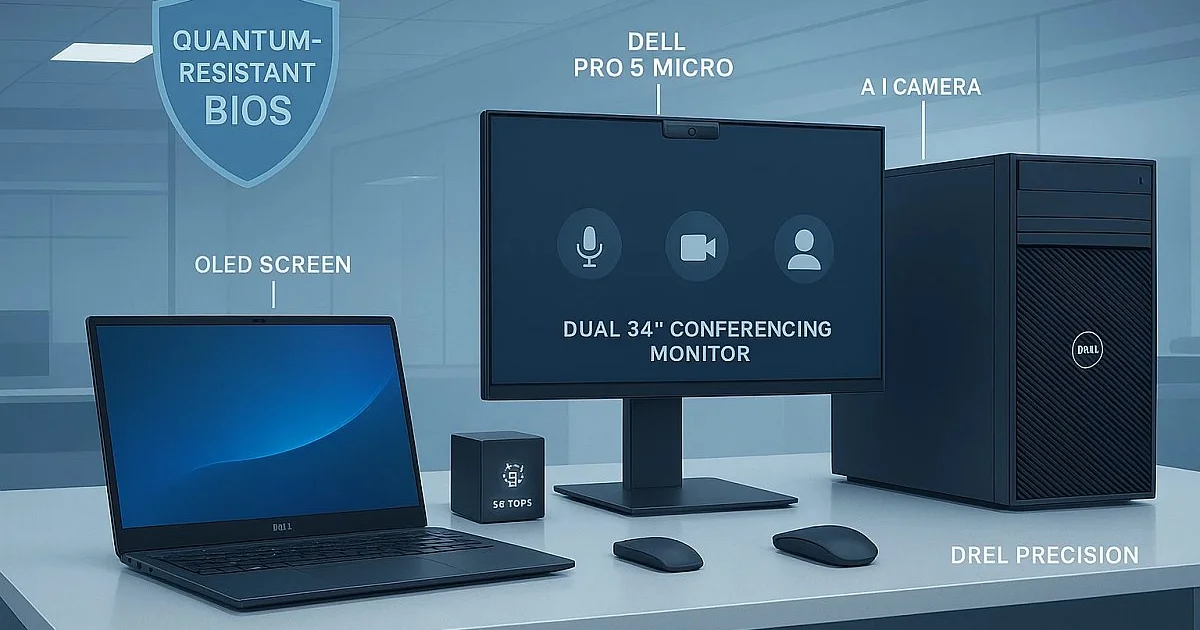
nDell Technologies also made significant announcements at NVIDIA GTC 2026 in March. They introduced a new lineup of professional workstations, including the Dell Pro Precision 9 Series T6 and T4 workstations. These feature Intel Xeon 600 processors (with up to 86 cores) and NVIDIA RTX Pro 6000 Blackwell GPUs [Source: petronellatech.com, storagereview.com].
nPerhaps most impressive is the Dell Pro Max with GB300a desk-side system built around the groundbreaking NVIDIA Grace Blackwell Ultra GB300 superchip. This offers up to 20,000 TFLOPS of FP4 computing power and 748GB of coherent memory, making it ideal for large-scale AI experimentation. Thomas Kurian, CEO of Google Cloud, praised Dell Precision AI-Ready Workstations for improving deployment consistency across data science teams [Source: storagereview.com]. Dell also introduced new Dell Pro Max 14 and 16 mobile workstations in September 2025, featuring AMD Ryzen AI processors with integrated NPUs.
nnNVIDIA's Personal AI Supercomputers
nNVIDIA itself is bringing datacenter-grade AI closer to individuals. On May 31, 2026, NVIDIA announced DGX Station for Windowsa personal AI supercomputer. It features up to 748GB of coherent memory and 20 petaflops of FP4 performance, designed to put powerful AI tools right on individual desks [Source: nvidia.com].
nNVIDIA also confirmed that its RTX Spark AI-PC superchip entered mass production, aiming to run capable AI models locally. Systems from Lenovo, Dell, HP, and Microsoft are expected to ship with this technology in Fall 2026 [Source: nvidia.com]. This means more people will have access to powerful local AI.
nnThe AI PC Market: Growth and What It Means for You
nThe market for AI PCs is not just growing; it's exploding. This rapid expansion shows how important and in-demand these powerful machines are becoming.
nnImpressive Market Size and Growth
nThe global AI PC market was valued at about USD 58.07 billion in 2025 and is projected to reach USD 69.19 billion in 2026 [Source: globenewswire.com]. Other estimates are even higher, placing the 2025 market size at USD 109.66 billion, growing to USD 131.81 billion in 2026 [Source: precedenceresearch.com]. A third report indicates a market value of USD 72.4 billion in 2025, expanding to USD 103.4 billion by the end of 2026 [Source: fortunebusinessinsights.com].
nThese numbers highlight a market that is not slowing down. Forecasts predict significant growth, with Compound Annual Growth Rates (CAGRs) ranging from 18.66% (2026-2035) to 42.8% (2026-2036). This could mean the market reaches USD 321.41 billion by 2035, USD 574.36 billion by 2034, or even a staggering USD 3,645.4 billion by 2036 [Source: globenewswire.com, precedenceresearch.com, fortunebusinessinsights.com].
nnHardware Dominance and Regional Shifts
nThe hardware segment, which includes all the components we have discussed, held the largest market share in 2025, making up nearly 45% of the total [Source: fortunebusinessinsights.com]. Within the AI PC market, workstations are expected to see the fastest CAGR, showing their critical role in professional AI work [Source: marketsandmarkets.com].
nGeographically, Asia Pacific held the largest market share in 2025, accounting for approximately 42%. However, North America is expected to be the fastest-growing market from 2026 to 2035 [Source: marketsandmarkets.com]. This indicates a global embrace of AI technology.
nThe broader Artificial Intelligence market itself is also seeing immense growth, valued at USD 439.36 billion in 2025 and projected to reach USD 601.93 billion in 2026 [Source: darulilmofficial.com]. This overall expansion fuels the demand for powerful AI workstations.
nnCompute Trends: Inference Takes the Lead
nAn interesting trend in AI compute is the rise of inference. Inference, which is the process of using a trained AI model to make predictions or decisions, now accounts for roughly two-thirds of all AI compute. This is a significant increase from just one-third in 2023 [Source: techfinitive.com]. This shift means that while training models still requires immense power, running those trained models efficiently is becoming even more prevalent.
nnBeyond the Hype: Real-World Impact and Future Outlook
nThese technological advancements are not just about faster computers; they are fundamentally changing how we work, create, and innovate. The implications are far-reaching for individuals and businesses.
nnDemocratizing AI Power
nThe rise of powerful AI workstations and personal AI supercomputers, such as the NVIDIA DGX Spark, means that advanced AI model training and running large language models can increasingly happen locally [Source: nvidia.com]. This reduces how much we rely on costly cloud services, putting more control and capability directly into the hands of creators and small studios. It's like having a miniature data center on your desk, ready to tackle complex projects.
nThis democratization of AI power means that smaller teams and individual professionals can access tools once reserved for large corporations. With powerful AI workstations handling complex model training or rapid content generation, platforms like BuildEZ.ai can then take that AI-generated content and quickly build a professional website, streamlining the entire creative workflow.
nnEvolving Workforce Skills
nAs mentioned earlier, the demand for AI proficiency is rapidly increasing, with 80% of entry-level creative jobs requiring AI skills by 2026 [Source: buildez.ai]. This means that AI is expected to handle more routine computer-based tasks, allowing humans to focus on higher-level, creative, and judgment-based work. Equipping yourself with a capable AI workstation becomes not just a convenience, but a career necessity.
nBusinesses are already seeing the positive impact. A significant 88% of businesses reported that AI has positively impacted their annual revenue, with 30% seeing increases greater than 10% [Source: buildez.ai]. Generative AI, when used well, can cut development and prototyping cycles by up to 70%.
nnAccelerated AI Development and Hybrid Architectures
nPredictions suggest a massive increase in AI training compute. Leading AI companies are expected to have 20-40 times more AI compute by December 2027 compared to December 2024 [Source: buildez.ai]. This astonishing growth will allow AI systems to conduct their own research, making years of progress in mere weeks. Imagine the pace of innovation this will bring.
nWhile NPUs are becoming standard for efficient, low-power inference, hybrid systems that combine powerful GPUs with NPUs will remain essential. This combination is perfect for demanding workloads like model training and complex experimentation, ensuring you have the right tool for every AI task.
nnFuture Hardware Trends
nWe can expect continued advancements in GPUs with even larger VRAM capacities and improved tensor processing units. Faster PCIe and memory technologies will also play a big part. Memory bandwidth is a growing bottleneck, so expect to see a lot of focus on new solutions to address this in the coming years. The goal is always more power, more efficiency, and seamless integration into our daily workflows.
nnBuilding Your AI Future with the Right Tools
nThe world of AI workstations in June 2026 is dynamic and exciting. Powerful hardware from NVIDIA, AMD, and Intel is making on-device AI a reality, bringing unprecedented speed, privacy, and cost efficiency to your work. Whether you are a developer training complex models or a designer generating new ideas, the right AI workstation is becoming an indispensable tool.
nThis local AI power helps creators, developers, and small businesses iterate faster and build complex projects with ease. Imagine fine-tuning a custom AI model on your local AI workstation, then instantly using its output with BuildEZ.ai to generate dynamic website content. BuildEZ.ai creates complete, production-ready websites, letting your advanced workstation focus on the heavy lifting of AI creation.
nReady to put this power to work for your online presence? Explore how BuildEZ.ai can help you launch stunning, AI-powered websites quickly, letting your advanced workstation focus on the heavy lifting of AI creation.